THE 2014 VIENNA DECLARATION ON FREEDOM OF INFORMATION AND EXPRESSION
We, the speakers of the Vienna 2014 International Conference "Freedom of Information Under Pressure. Control – Crisis – Culture" (comprised of international academics, media practitioners, librarians, experts of open culture and public space, activists, critical citizens, lawyers and policy makers), sign the following declaration on Freedom of Information and Expression:
Having met in Vienna of Austria on 28 February and 1 March 2014 and having discussed the challenges of freedom of information in the light of the recent surveillance revelations and the increase in censorship and prosecutions of media, journalists and whistle-blowers in Europe and beyond, we express our deep concern and appeal for public vigilance to defend freedom of information and expression as key democratic rights.
Read more: THE 2014 VIENNA DECLARATION ON FREEDOM OF INFORMATION AND EXPRESSION
About this conference
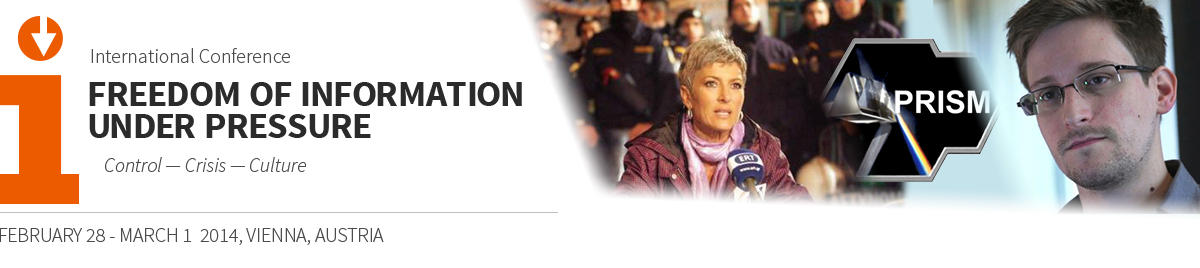
The University of Vienna, the transform!at Association and the Critical Librarians Association (KRIBIBI) are pleased to invite you to the International Conference "Freedom of Information under Pressure. Control - Crisis - Culture", which will take place in Vienna on the 28th of February and 1st of March 2014. The event has been endorsed and supported by the Mayor and Governor of the city of Vienna, Michael Häupl (patronage), as well as by a number of organisations and institutions, such as the Austrian Ministry of Science and Research, the Austrian Federal Ministry for Education, Arts and Culture, Association of European Journalists (AEJ), the Centre for Freedom of the Media (CFOM) of the University of Sheffield, the International Press Insitute (IPI) and the University of Westminster. The realisation of the conference was made possible by the generous support of our partners.
This event will gather more than 30 international speakers (academics, media practitioners, librarians, experts of open culture and public space, activists and policy makers) from Austria, Belgium, Bulgaria, Germany, Greece, Spain, Sweden and United Kingdom, and will call for an open discussion on the challenges of freedom of information in the light of the recent surveillance revelations and the increase in censorship and prosecutions of media, journalists and whistle-blowers in Europe and beyond.
Keynote and plenary speakers include:
- Gill Phillips (Director of Editorial Legal Service, The Guardian, United Kingdom)
- Augoustine Zenakos (Investigative Journalist, UNFOLLOW magazine, Greece)
- Mariniki Alevizopoulou (Investigative Journalist, UNFOLLOW magazine, Greece)
- Christian Fuchs (Professor of Social Media, University of Westminster, United Kingdom)
- Joachim Losehand (Scholar, VIBE!at, Austria)
- George Katrougalos (Professor, Democritus University of Thrace, Greece)
- Wolfgang Hofkirchner (Professor, Vienna University of Technology, Austria)
- Erich Möchel (Investigative Reporter, ORF, Austria)
Important information:
- The event is public, open to everyone and free but registration is essential. If you would like to attend, you can register here. Light lunch, coffee and refreshments will be provided.
- The official language of the conference will be English with simultaneous interpretation to German and Greek.
- The conference will be filmed and shared online afterwards, as well as streamed live by the kind offer of The Press Project.
- The conference minutes will be published in an edited volume (more details to come).
Theme of the conference:
In June 2013, Edward Snowden, with the collaboration of The Guardian, The Washington Post and Der Spiegel, revealed – and most importantly attested - the extent of the American and British intelligence agencies surveillance activities. These activities include mass online surveillance but also mass mobile and landline telephone surveillance, covering nearly all-possible communicative transactions. Such efforts of individual whistle-blowers and organisations towards transparency and public accountability have been met with vigorous oppression; Chelsea Manning (previously known as Bradley Manning) was recently sentenced to 35 years of imprisonment for leaking US classified information, while others, such as Julian Assange, Edward Snowden, Laura Poitras and Glenn Greenwald have been chased and prosecuted by the US and British governments, in an effort to curtail disclosures and prevent others from proceeding to similar activities. Moreover, in a concerted intimidation effort, the British government recently asked the Guardian newspaper to appear before a parliamentary committee under the accusation that the newspaper has threatened national security.
Meanwhile, we have been experiencing a general increase in media and journalism censorship in Europe, where freedom of information is under pressure. In the crisis hit country of Greece for instance, journalists are often threatened and prosecuted by public and private institutions and organisations. One notorious case was that of the Greek Public Service Broadcaster, ERT, which was brutally shut down by the Greek government, laying off around 2,600 employees and causing an international public outcry. Another case was that of the investigative journalist, Kostas Vaxevanis, who was prosecuted for publishing the so-called "Lagarde's List", which contained over 2,000 names of Greeks, alleged to have bank accounts in Switzerland.
The right of access to information can promote citizens civic and political participation by raising their levels of trust in political and policy making institutions, while it can fight phenomena such as lobbying and corruption. Open access to public and digitised knowledge and scholarly research is also crucial for the continuous education of the broader public and professionals, the promotion of cultural production and diversity and the preservation of the historic and collective memory. Libraries and archives can and should play an important role in this debate. However, the potentials created by access to information and public knowledge are hampered by various, complex, technical and legal barriers and their success is heavily dependent on governments' unwillingness to adopt laws for transparency and access to information but also on citizens' ability to claim such conditions of access and to demand accountability.
In this context, the conference aims to explore the following urgent questions: What is the state of media and journalism freedom currently in Europe? What are the differences and the similarities between European countries? What is the relationship between security policies and press freedom? What do we know about electronic surveillance and why does it threaten democracy? What is the relationship between security, privacy, data protection and surveillance? How can we take advantage of the new information and communication technologies, without giving away fundamental freedoms, such as the right to privacy? How can the rights of creators be secured without hampering cultural and scientific progress and exchange? What is the role of researchers, publishers, libraries and archives in the promotion of a free culture of information and knowledge? What role can commons-based peer production play in reforming current copyrights laws? What has to be done in order for decision-making processes and their results in policy and administration to be more transparent? What are the challenges for policy makers, NGOs and advocates of digital rights, privacy, freedom of information and open access? What are the technological, legal, educational and political strategies for resistance to the spreading of societies of censorship, surveillance and control?
Aims of this conference:
The Organising Committee is interested in dynamic panel debates and dialogue and the development of synergies as an outcome of the event. In addition, by setting the event open to the wider public we aim to stimulate the public discussion and suggest a new agenda on Freedom of Information issues for policy makers, media practitioners, organisations and civic society actors.